
Outreach and education
Video gallery
Audiovisual records of fieldwork and Patagonian marine wildlife.
The work of Argentine scientists
Monitoring the life of penguins and other species around the clock.
The determination and skill of Argentine scientists make it possible to monitor the life of penguins and other species of the south of the country, after installing cameras and an internet connection on remote islands, without disturbing the birds and collecting data related to the incubation and rearing of the chicks live and in real time, even at night.
Identification of individuals
Use of implanted subepidermal transmitters (PITs).
The use of radio transmitters the size of a small grain of rice allows us to identify individuals over the years. Each animal is identified by a unique radio frequency that is detected by handheld antennas when researchers monitor the nests.
Monitoring of Penguin Nests
Recording and tracking of nests, breeding pairs, eggs and chicks.
Adults, eggs and chicks are marked for identification during each breeding season. This task makes it possible to obtain essential information on the reproductive biology of the species over time.
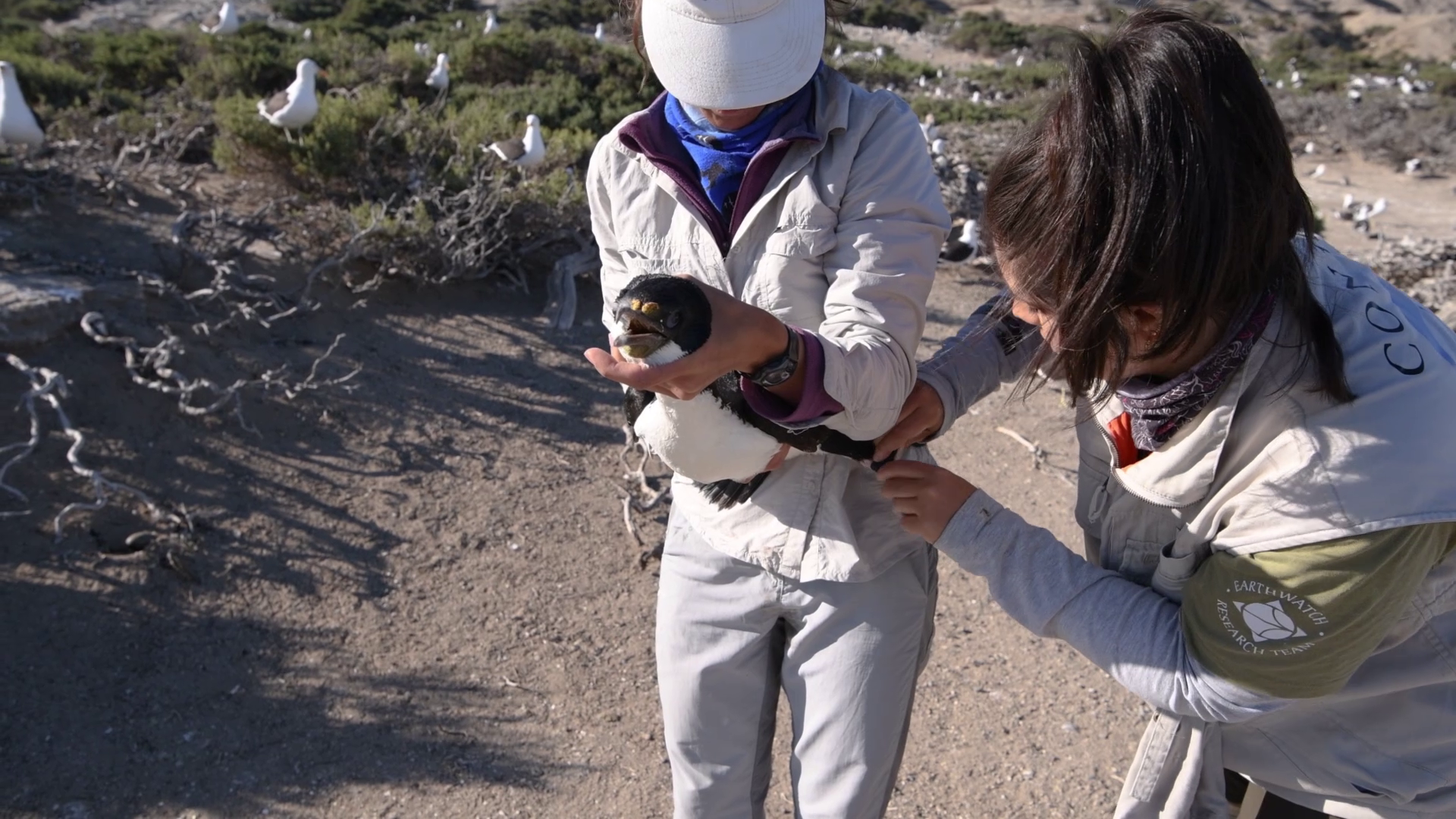
Capture and Handling of Penguins
Safe and responsible techniques that maximize animal welfare.
The capture and handling of wildlife is carried out under animal care and welfare protocols. This work requires field experience with each of the study species.
Deployment of Electronic Data Loggers on Cormorants
Movement and behavior studies using state-of-the-art electronic technology.
Electronic movement and behavior data loggers provide information on position, speed, diving depth, body orientation, prey consumption and energy expenditure while the birds are feeding at sea.
Drone Surveys
Population censuses and recording of environmental changes in breeding colonies.
The use of drones is key for demographic studies related to the variation in the size of the breeding populations of colonial seabirds. In turn, through spatial models, it is possible to monitor environmental changes and changes in the appearance of the colonies over time.
Monitoring of Cormorant Nests
Recording and tracking of nests, breeding pairs, eggs and chicks.
Adults, eggs and chicks are marked for identification during each breeding season. This task makes it possible to obtain essential information on the reproductive biology of the species over time.
Deployment of Electronic Data Loggers on Penguins
Movement and behavior studies using state-of-the-art electronic technology.
Electronic movement and behavior data loggers provide information on position, speed, diving depth, body orientation, prey consumption and energy expenditure while the birds are feeding at sea.
Feeding and diving behavior in Cormorants
Use of accelerometers to determine underwater behaviors.
Small accelerometers placed on the body and/or head of the birds allow us to determine the orientation and movements of each part of the body. This, in turn, translates into precise determinations of behaviors and prey captures underwater.